My latest reports on the world of sports. Welcome to Vaughn's World Sports Network. Here, you will receive nothing but pure, absolute, unbiased facts and opinions on the world of sports. I was inspired to create this, because of my undying passion for sports, and love of history. For those who desire a healthy combination of history with modern facts, this is the place for you. Follow me on Twitter: @301kingvaughnjr
50. Wes Unseld
49. Willis Reed
48. Gary Payton
47. Russell Westbrook
46. Dominique Wilkins
45. Clyde Drexler
44. Elvin Hayes
43. Kevin McHale
42. Walt Frazier
41. George Gervin
50. Wes Unseld- The ultimate undersized Center. Despite being 6'7", Wes Unseld made up for his lack of traditional size at Center with a defensive presence that made him as immovable as a DC monument. Coming out of Kentucky as the 2nd Overall pick in 1968 behind future teammate Elvin Hayes, Wes made an immediate impact. As a rookie (1968-69), Unseld joined Wilt Chamberlain (1959-60) as being only one of two Rookies to win both Rookie of the Year & MVP in the same season. Wes went on to average 13.8 ppg while his rebounding peaked with a career-high 18.2 rpg as he also earned his first of five All-Star selections. In 1969-70, Unseld's scoring peaked with a career-high 16.2 ppg. However, he missed out on the All-Star team. In 1970-71, Wes would lead the Baltimore Bullets (later Washington) to their first NBA Finals appearance. However, the Bullets would get swept 4-0 to the Milwaukee Bucks, led by Lew Alcindor (later Kareem Abdul-Jabbar), and Oscar Robertson. Unseld proved to be one of the toughest defenders of his era as he led the league in rebounding in 1974-75 (14.8 rpg). Along with "The Big E", Wes would lead the Bullets to a 60-22 record as they would tie the Celtics for first in the Eastern Conference. However, history would repeat itself but this time the Bullets would fall in a sweep to Rick Barry's 8th seeded Golden State Warriors. The Bullets would finally bring a championship to DC as they defeated the Seattle Supersonics in 1978, as Unseld was the Finals MVP. After retiring in 1981, Unseld would be enshrined into the Basketball Hall of Fame in 1988. The legacy of Wes Unseld is that he was the greatest star for the Wizards in the franchise's greatest era as he would continue to be a staple for the organization even in the front office. On June 2, 2020, Unseld passed away after lengthy health battles, including pneumonia. However, his mark in DC and NBA history still lives.
49. Willis Reed- The shining season of Willis Reed's career came in 1970. That season, he became the first player in NBA history to win All-Star Game MVP, Regular Season MVP, and Finals MVP in one year. He also made the All-NBA 1st Team, and All-Defensive 1st Team. The most heroic moment of his career came in Game 7 of the 1970 NBA Finals, where he limped to the court and inspired his team to victory. Willis Reed was a very fearlessly, tenacious player, on offense and defense. His career high scoring average was 21.7 ppg. He also averaged a career-high 14.6 RPG. Reed would go on to win another Finals MVP in 1973, but injuries would diminish his effectiveness. The year 1970 will forever be the defining year for Willis Reed's legacy. Reed was also the "Sporting News MVP", in a year with strong competition at his position. Willis Reed was a 2-time NBA Finals MVP, 1-time NBA MVP, All-Star Game MVP, 7-time All-Star, 1-time All-NBA 1st Team selection, 1-time All-Defensive 1st Team selection, and a 4-time All-NBA 2nd Team selection. Willis Reed is a Basketball Hall of Famer.
48. Gary Payton- Gary Payton was one of the most intense, hands-on, lockdown defenders of all-time. "The Glove" was a perfect nickname for his defensive style because he was constantly ready to pick an opposing player's pocket for a steal. Payton was one of the most dangerous perimeter defenders of all-time, along with the likes of Michael Jordan & Scottie Pippen. Not only was he a supreme defender, but he was a good offensive player. Gary Payton was the face of the Seattle Supersonics franchise, as the team's all-time leader in points, assists, and steals. Even though he never won an MVP Award, Gary Payton's greatness cannot be denied. Unfortunately, Gary was in the gigantic shadow of the "Michael Jordan Era", which crippled the legacies of many great players. Not only was Payton overshadowed by Air Jordan himself, but also by other players such as Hakeem Olajuwon, Karl Malone, David Robinson and others. Still, GP found a way to stand out. Gary Payton was one of, if not the best two-way Point Guard in NBA history as it pertains to offense and defense. During his prime, Payton was a 20 ppg, 8 APG, guy. In 1996, The Glove enjoyed his defining season. That season, he won Defensive Player of the Year, leading the league in steals with a career-high 2.9 SPG. Payton also led the Sonics to the NBA Finals, where they fell to Jordan's 72-win Bulls in a tough, hard-fought defensive series. In 1999-2000, GP's scoring peaked at 24.2 ppg, while his rebounding peaked at 6.5 RPG. In 2001-'02, his passing peaked at 9.0 APG. In 2006, Gary Payton finally enjoyed the championship success that he desired for years when he won as a member of the Miami Heat. Gary Payton is tied with Michael Jordan and Kobe Bryant for most All-Defensive 1st Team Selections in NBA history with 9. Payton and Jordan are the only players to win DPOY, with those 9 selections. GP was also named to 2 All-NBA 1st teams, All-NBA 2nd Team 5 times, All-NBA 3rd Team three times, and 9 All-Star selections. Gary Payton will soon be a Hall of Famer, and is already a legend.
47. Russell Westbrook- One of the more polarizing players of recent NBA History besides LeBron. An energetic point guard with the firepower of a shooting guard. Praised for his intensity and athleticism, but is famous for making critical errors because of his ball-dominant style of play. Russell Westbrook is definitely the prototype for a score first, ask questions later point guard. After being drafted 4th Overall by The Oklahoma City Thunder in 2008, Russell would join forces as the sidekick to Kevin Durant as they would be seen as the Team of the future. Durant & Westbrook definitely had shades of Shaq & Penny Hardaway for the Orlando Magic during the mid 90s. After finishing fourth in NBA Rookie of the Year voting to Derrick Rose, Westbrook would improve the next season as he became a full-time starter. In 2009-2010, The Thunder made a significant turnaround where they more than doubled their wins as they finished with a 50-32 record. These were the first signs of promise as OKC legitimized themselves as contenders in the West. However, they would eventually fall to the back to back Champion Los Angeles Lakers in the first round. In 2010-11, Russell made his first All-Star selection as a reserve for the Western Conference. That season, he was the best second option for KD by contributing with 21.9 ppg, 8.2 apg, 4.6 rpg. OKC would prove once again that they were a vital threat in the West before falling in the Western Conference Finals to Dirk Nowitzki's Dallas Mavericks. As we know, the Mavs would eventually become the NBA Champions that year. Not only was Nowitzki driven, but Russ also had streaky shooting that hurt the team. In 2011-12, the Oklahoma City Thunder finally made their breakthrough by making their first Finals appearance in franchise history apart from the Seattle Supersonics. Unfortunately, the Thunder would fall to the Miami Heat (4-2), led by LeBron James and his other Big 3 teammates, Dwyane Wade and Chris Bosh. That Thunder team would never return to the Finals. Russell would have another All-Star campaign in 2012-13 before having a second surgery on his right knee prior to the 2013-14 season. The surgery would drastically hinder his performance that season including arthroscopic surgery on his right knee that would keep him out through the All-Star Break. As a result, OKC remained competitive because they relied heavily on the performance of franchise star Kevin Durant, who would go on to win MVP. I believe this is what turned their competitiveness into a deeper sense of jealousy. After finishing 59-23, the Thunder finished 2nd in the Western Conference behind the San Antonio Spurs. OKC would lose to the eventual Champion Spurs in the WCF, as Westbrook would average 26.7 ppg, 8.1 apg, 7.3 rpg in the postseason. He would also become the first player since Oscar Robertson in 1964 to average at least 26 points, 8 assists and 7 rebounds in the playoffs. Clearly, this was only a sign of bigger things. The tables would soon turn as Kevin Durant would be sidelined for most of the 2014-15 season after being diagnosed with a Jones fracture in his foot. KD would only be available for 27 games, which left room for Westbrook to shine, as he led the NBA in scoring for the first time in his career (28.1 ppg). In his return to the All-Star Game, Russ won ASG MVP with 41 points. Westbrook set a record for most All-Star points in a half (27), as he finished one point shy of Wilt Chamberlain's 1962 total of 42. He also became the first player since Michael Jordan in 1989 to record four consecutive triple-doubles. However, Westbrook's individual brilliance was not enough as the Thunder missed the playoffs with a 45-37 record, placing them ninth in the West. The 2015-16 Season is when things finally began to truly implode. On October 30, Russ and KD both scored 40 points against the Orlando Magic. That is fitting because this season would be 20 years since Shaq & Penny's last season in Orlando. KD was Shaq and Russ was Penny and the parallels became even more obvious as their egos grew larger. There was not enough Basketball for either of them. Westbrook would earn his second All-Star MVP Award in 2016. This season, he would go on another triple-double run which led to averaging 10.4 apg for the first time in his career. However, the Thunder would implode after notoriously blowing a 3-1 lead to the 73-9 Golden State Warriors. This would lead to one of the biggest break ups in NBA History next to Shaq's breakups with Penny & Kobe as Durant would leave and join the rival Warriors. The chemistry was already deteriorating, and this confirmed what was going to inevtiably happen. As a result, Russell would have his signature season in 2016-17 as he would become the first player since Oscar Robertson in 1961-62 to accomplish this feat. Russ would go on to have three consecutive triple-double seasons. This was Westbrook at his best as his scoring also peaked with a career-high 31.6 ppg, making him the league's scoring champion. He also enjoyed career-highs in 3-point percentage (34.3%) and free-throw percentage (84.5%). As a result of this historic season, Russell won NBA MVP (31.6 ppg/10.7 rpg/10.4 apg). I believe this was his vengeance season since KD went to Golden State. He also became the first player to win MVP with less than 50 wins since Moses Malone in 1982. However, the Thunder would suffer an embarrassing first round playoff exit thanks to James Harden's Houston Rockets, 4-1. Meanwhile, Kevin Durant would have the last laugh winning his first two straight NBA Championships as the Warriors conquer the Cavs, 4-1. Russell would have two more triple-double seasons but they would both end in first round failures like his MVP campaign. The biggest embarrassment came at the hands of Damian Lillard & the Portland Trailblazers, which would culminate in Westbrook getting traded to the Houston Rockets for Chris Paul. Westbrook would enjoy a brief reunion with former OKC Thunder teammate James Harden. However, the fun would be short lived as the Rockets would fall to the eventual NBA Champion Los Angeles Lakers. After that experiment blew up, the Rockets would trade Russ to the Washington Wizards. Unfortunately, the Wizards missed the postseason. As he continues to write out his story, there is no doubt that Russell Westbrook has already made history for this game.
46. Dominique Wilkins- Dominique Wilkins was one of the NBA's most dynamic scorers and high-flyers in his prime. Dominique was truly a Human Highlight Film, as he captured the imagination of fans everywhere with his powerful windmills, alley-oops, and tomahawk dunks. In 1986, Dominique won the NBA scoring title, as he led the league with 30.3 ppg. That season, he also made his first All-Star Game, as well as his only All-NBA 1st Team appearance. From that point, Michael Jordan would soon take force as the scoring champ. Unfortunately, Dominique's legacy was overshadowed and swallowed up by the era of Magic/Bird/Jordan. Many fans simply remember the battles with Michael Jordan in the dunk contest but don't go to further educate themselves. People rarely mention Dominique's classic game 7 battle against Larry Bird in the Eastern Conference Semi-finals in 1988. That season, Dominique's scoring average peaked at 30.7 ppg. Wilkins carried above-average to good Atlanta Hawks teams. None of those teams were great & elite. As a result, his legacy was further squashed, because the Hawks had to fight the Juggernauts of the East (Mid-'80s Celtics, Late-'80s Pistons, Early-'90s Bulls). Nique was amazing in the open court for the fast break. He also had a pretty decent post game, and soon became a better shooter. His rebounding also peaked at 9.0 RPG. Wilkins also had 10 straight seasons with 25 ppg. However, one of the most surprising things that I have found about Dominique was that he was a volume scorer. His career average was 46%. This is pretty ironic, considering much of his game involved attacking the basket. For me, that hole is not quite as large as the hole of not having the right supporting cast. I believe that if Dominique Wilkins and James Worthy switched places, Nique would be the one with multiple championships with Magic, Kareem & co. (no offense Worthy) Dominique's career numbers prove that he is another great case study of someone's legacy being hindered because of the team, not the player themselves. Dominique Wilkins was a 9-time NBA All-Star, 1-time All-NBA 1st Team selection, a member of 4 All-NBA 2nd Teams, and 2 All-NBA 3rd teams. Dominique Wilkins is a Basketball Hall of Famer and a very overlooked legend.<
45. Clyde Drexler- Amazing high-flyer, Incredible all-around player. Clyde "The Glide" Drexler was truly a fantastic athlete, great ballhandler, thinking man's player, excellent defender and progressed into a better shooter. Here is one of the many forgotten perimeter players from the Magic/Bird/Jordan era, who held his own, but was greatly overshadowed. Drexler was terrific on the fast break finishing plays with incredible dunks & layups during an incredibly physical era. Today's new-school fanboys don't understand, and many refuse to. He was the definition of a player with incredible grace, style, and class much like others such as Julius Erving, David Robinson, and Hakeem to name a few. Clyde Drexler is the greatest player in Portland Trailblazers history. During the '80s/early '90s, Clyde Drexler was the closest matchup to Michael Jordan, along with Dominique. Even Drexler & Jordan's nicknames were identical. "Clyde The Glide" vs. "Air Jordan". Clyde-6'7", MJ-6'6". Drexler-210, Jordan-200. Their head to head matchups was absolute classics. Even against The Greatest, Clyde was able to handle himself very well. Drexler's first true breakout season was in 1987-88, where he averaged 27.0 ppg/6.6 rpg/5.8 APG. One of Clyde's greatest individual season came in '88-'89, where his scoring peaked at 27.2 ppg, and his rebounding peaked out at 7.9 RPG along with 5.8 APG. Drexler also averaged a career-high 2.7 SPG that season. Those look very close to LeBron-type numbers. In '89-'90, Clyde Drexler led the Blazers to the first of 2 Finals appearances ('90, '92). Very interesting to note that Clyde led the Blazers to the Finals the year before MJ. Another similarity in their legacy is that they were dynamic high-flying guards that battled the physically brutal "Bad Boy" Detroit Pistons Defense. In '91-'92, Drexler and Jordan finally met each other in the NBA Finals. That season, Drexler averaged 25.0 ppg/6.6 rpg/6.7 APG and finished 2nd place in MVP Voting behind Michael Jordan himself. That season, he also made his first and only All-NBA 1st Team Selection. The comparisons & buildup from the media were very strong, much like a heavyweight fight. The media desperately needed a new rivalry & story for the '90s, since Magic & Bird were out of the picture. The stage was set, as everything finally culminated during that Finals. Jordan certainly came out victorious, but Drexler's supporting cast failed, as his sidekick Terry Porter fell flat. After two straight drop-off seasons, Clyde Drexler realized that he was on the decline and Portland needed to rebuild. That rebuilding process involved him going to a better team, where he could finally win a ring. Midway through the '94-'95 season, Drexler was traded to the Houston Rockets for Otis Thorpe, so that he could reunite with former college teammate Hakeem Olajuwon. During the playoffs, Drexler was fantastic as Olajuwon's sidekick during that 1995 Rockets Championship run. Drexler was also a 10-time NBA All-Star, All-NBA 1st Team Selection 1 time, All-NBA 2nd Team 2 times, and All-NBA 3rd Team 2 times. Mr. Clyde Drexler is indeed a Basketball Hall of Famer and NBA legend.
44. Elvin Hayes- "The Big E" Elvin Hayes was certainly a force on the basketball court. After an outstanding college career at the University of Houston, Hayes was drafted 1st overall in the 1968 NBA draft. Expectations were strong, and he did not disappoint. Elvin Hayes put the NBA on notice ('68-'69), as he led in scoring (28.4 ppg) and rebounding (17.1 RPG). Hayes was the second, and the last player to do so since Wilt Chamberlain (1959-60). To this day, I am still mind-boggled as to why the Big E did not win Rookie of the Year & MVP (both awards went to future teammate Wes Unseld). In '70-'71, Elvin's scoring peaked at 28.7 ppg. After that season, the San Diego Rockets would move to Houston. This is the same place where Hayes first made his mark in college at UH. However, the reunion only lasted one season, as Hayes was traded to the Baltimore Bullets in 1972. Elvin Hayes' run from '68-'72 was unbelievable. Every year, he averaged over 25 ppg, and 3 years over 16 RPG. As a Bullet, Elvin sacrificed his numbers, because he was surrounded by a better overall team. In 1973-'74, Elvin Hayes led the league in rebounding again, as he averaged a career-high (18.1 RPG). The front-court combo of Elvin Hayes and Wes Unseld was deadly for other teams. Together, they led the Bullets to 3 Finals appearances (1975, '78, '79). The Bullets won in 1978, over the Seattle Supersonics. Elvin Hayes had 13 seasons where he averaged a double-double. The others to do that include Wilt, Russell, Moses Malone and Shaq. He would have had 16, had his streak not ended in '81-'82. However, Hayes did average a double-double every season in the playoffs. Elvin Hayes was a model of durability, as he has played over 80 games every season. He also has exactly 50,000 minutes. However, the biggest knock that I have for Elvin Hayes would be his field goal percentage. As a big man, he was surprisingly inaccurate as he only shot 45% for his career. He was also often known as a player that came up short under pressure in the playoffs & big games. Hayes also had a reputation for not being a great team player. Elvin Hayes was a 12-time NBA All-Star, 3-time All-NBA 1st Team selection, 3-time All-NBA 2nd Team selection, 2-time All-Defensive 2nd Team selection, Scoring Champion, NBA champion (1978 Bullets), 1968 Sporting News & Associated Press Player of the Year. Elvin Hayes is a true Basketball Hall of Famer & legend.
43. Kevin McHale- From quintessential 6th Man to being on the front line with Larry Bird and Robert Parish for the Celtics Big 3, Kevin McHale was also a pioneer for low-post moves. Thanks to his long arm reach, McHale was able to destroy defenders in the post offensively as well as be a nightmare on defense. His wingspan is listed as 8'0", which is even longer than Kevin Durant's wingspan (7'5"). Kevin's defensive prowess earned him 6 All-NBA Defensive Team selections along with his 7 All-Star selections. McHale's presence proved critical for Boston's championship success in the 80s as the Powerhouse of the East to counter the Showtime Lakers dominance in the West. Charles Barkley has gone on record to say that Kevin McHale was the toughest player that he ever guarded, which is all you need to know as a testament to his skill. He also won back to back 6th Man of the Year Awards (1984, 1985). Both of those seasons, the Celtics faced off against the Lakers in the Finals. Boston would win in 1984 (4-3), where the signature play of the series was McHale knocking Kurt Rambis' head off with a clothesline mid air. The next season, the Lakers would get their revenge. In 1985-86, Kevin McHale would become a full-time starter for the Celtics as the impact would become immediate. That season, he would join Bird, Parish, Dennis Johnson and Danny Ainge to establish a green machine that would steamroll the NBA with a league best 67-15 record. When it comes to single seasons, this could very well be considered not only the best Celtics team of all-time, but arguably the best team in NBA History. A case could be made for this team with the likes of the 1996 Chicago Bulls, 2017 Golden State Warriors and many others. In 1986-87, his scoring peaked at 26.1 ppg along with his rebounding at 9.9 rpg, along with leading the league in Field Goal % (60.4). This season was a flagship in other ways as McHale would become the first player in NBA History to shoot 60% from the field or better while shooting 80% or better from the free throw line (83.6%). This season would reward him with his only All-NBA 1st Team Selection. However, McHale's foot injury would come back to bite him as the Lakers would vanquish the Celtics (4-2). Kevin would lead the league in FG% once again in 1987-88 with the same percentage. Injuries would later derail him, but Kevin already proved to be the premiere Power Forward of the 80s as he was part of one of the greatest frontcourts in NBA History. Much like James Worthy with the Lakers and Scottie Pippen with the Bulls, Kevin McHale played an integral sidekick role that proved to be a strong backbone for his team's success.
42. Walt Frazier- Many fans may remember Walt "Clyde" Frazier for his style off the court and cool demeanor. He was the embodiment of "swagger", long before the term was even created. Even today, he still displays it as a color commentator for the Knicks. However, that should not overshadow how excellent of a player he was while on the court. Frazier was very good offensively, but defensive is where he thrived. He was definitely innovative when it came to on-ball defense as he gave offensive players very hard times. The famous "Willis Reed Game 7" of the 1970 NBA Finals was Frazier's defining moment. In that game, Frazier dropped 36 points and 19 assists to lead the Knicks to their first NBA title over the Los Angeles Lakers. In 1971, the New York Knicks acquired Earl "The Pearl" Monroe in a trade with The Baltimore Bullets. Together, Walt "Clyde" and Earl "The Pearl" formed "The Rolls Royce Backcourt". There were also questions about Monroe & Frazier's chemistry because both players were stars that needed the ball in their hands. Frazier himself has even referenced this before, but it was pure speculation. Obviously, they were able to coexist, as they led the Knicks to their second title in 1973. They formed one of the greatest backcourt duos in NBA history, as both men are Hall of Famers. Walt Frazier's effectiveness on both ends was amazing. His scoring peaked at 23.2 ppg, rebounds at 7.3 RPG, and passing at 8.2 APG. Walt Frazier was a co-leader of 2 NBA Championship Teams, a 7-time NBA All-Star, 4-time All-NBA 1st Team selection, 2-time All-NBA 2nd Team selection, and a 7-time All-Defensive 1st Team selection. Walt Frazier is a Basketball Hall of Famer and a legend.
41. George Gervin- A smooth operator. A terrific scorer with amazing finesse. Master of the finger roll. George Gervin was the definition of "cool". His finger roll was his greatest weapon to become an all-time elite NBA scorer. That, along with his incredible shooting touch and versatility earned him 4 NBA scoring titles. Only Michael Jordan & Wilt Chamberlain have won more scoring titles (Jordan-10, Wilt-7). Gervin knew how to put up 40 point games in a very quiet and effortless fashion. George Gervin won three straight from '78-'80, and again in '82. That, along with his cool demeanor earned him the nickname "The Iceman". Like Dr. J, Gervin was an import from the ABA. When Iceman joined the NBA in 1976, he turned his game up to a higher level. He also had great battles against the great Doctor J. His scoring peaked in 1980, with 33.1 PPG, his rebounding peaked at 8.3 RPG and passing at 3.5 APG. Gervin played 14 total seasons when you include ABA/NBA. 12 of those seasons were with the Spurs (3-ABA, 9-NBA). His accuracy was incredible for a perimeter player. Gervin shot 50% from the field while shooting 84% from the free throw line. Out of today's players, Kevin Durant's game draws the most comparisons to George Gervin. However, Iceman's career draws more parallels to James Harden. Great scorers who were overshadowed by players that were more transcendent. For Gervin, he was lost in the shuffle because of stars like Kareem, Magic, Moses, Larry and Dr J. It was hard to break through the ceiling when those guys have their feet on it. Gervin has garnered respect from players and fans, both past and present (myself included). The Iceman's style of play was certainly influential because it was smooth and over the top. The main holes in Gervin's game were his lack of defense, and never leading his team to a championship. Nonetheless, Gervin's body of work was still impressive. Gervin was a 4-time NBA scoring champion, 9-time NBA All-Star, 3-time ABA All-Star, NBA All-Star Game MVP, 5-time All-NBA 1st Team selection, 2-time All-NBA 2nd Team selection, Two-time All-ABA 2nd Team selection, and a member of the All-time ABA team. When you include his ABA numbers, Gervin scored over 25,000 points (26,595 points). George Gervin is a Basketball Hall of Famer and a true legend.
Here I am with another Installment of "History Rewritten", where I will look back on history from my perspective, and do my own reevaluations. This is coming from the world of my views, as I crown who I feel deserved to win certain awards, especially MVP Awards. This time, I will revisit the 1969 and 1970 NBA MVP Awards. This award was even more suspect than the 1962 MVP Race. Bill Russell, Wilt Chamberlain and Oscar Robertson each had the strongest cases for that year's Award. Russell was the Centerpiece (pun intended) for a Celtics Juggernaut, as he reigned supreme to win his second straight out of three MVP's at that point in his career. Bill dominated in his typical fashion, as the Defensive Architect and Consummate General. Wilt Chamberlain poured in an Astronomical 50/25 that season while shooting roughly 51% from the floor. The Big O also did the unthinkable when he recorded a full-fledge Triple Double. Never seen before, and never seen since. In the end, I had to revisit and crown Wilt as my MVP that season.
That race was more respectable, despite the favoritism that went in Russell's favor. However, the next MVP race that I will cover was even fishier than that. That is the 1969 MVP Race. The winner of the MVP that season was also the Rookie of the Year:
Wes Unseld:
Unseld's Season Statistics: (13.8 ppg/18.2 rpg/2.6 apg/47.6% FG/60.5% FT)
Don't get me wrong. Wes is a Hall of Famer and a Basketball legend, but there is no way that you could convince me that he was the Most Valuable Player of the entire league. He is in the history books next to Wilt Chamberlain as the ONLY two players to win both ROY (Rookie of the Year) and MVP (Most Valuable Player) in the same season. Wilt, I could understand. From the start, Chamberlain was an Unstoppable Beast on the court. You don't need metrics or analytics to determine how obviously great a player that Wilt was. On the other hand, Unseld did not come across to me as someone on that level that could win MVP as a rookie. I might be wrong, but there were players more compelling than him to win the MVP.
Here are the stats for Unseld's rivals that season:
Willis Reed: (21.1 ppg, 14.5 rpg, 2.3 apg, 52.1% FG, 60.5% FT)
Billy Cunningham: (24.8 ppg, 12.8 rpg, 3.5 apg, 42.6% FG, 74.7% FT)
Bill Russell: (9.9 ppg, 19.3 rpg, 4.9 apg, 43.3% FG, 52.6% FT)
Elgin Baylor: (24.8 ppg, 10.6 rpg, 5.4 apg, 44.7% FG, 74.3% FT)
Unseld won the MVP with 310 voting points and 53 first place votes.
Unseld's Competition:
Willis Reed: 137 (18 first place votes)
Billy Cunningham: 130 (15 first place votes)
Bill Russell: 93 (11 first place votes)
Elgin Baylor: 89 (6 first place votes)
With all things considered, my MVP choice for that season would be none other than the future MVP for the next season:
The Knicks were a team on the verge of breaking the glass ceiling to win their first NBA Championship. Reed was a major player during that season, and his production is proof of that. The Knicks were on the doorstep, but were held from going inside because the Celtics still held the key in Bill Russell's final season. Speaking of Russell, it is a testament to how special he was to even be considered as a candidate. At this point, I would not have voted for him but interesting. Billy Cunningham took on a new load after Wilt Chamberlain left the 76ers to go to Hollywood and play for the Los Angeles Lakers. That season, Cunningham played at a level worthy of MVP Consideration. The Kangaroo Kid was a very significant part of the Sixers Championship Season in 1967. He was very much in his prime, so it made perfect sense. Elgin Baylor had a great season with still something left in the tank to offer even though his knees would start to betray him. Jerry West and Wilt would have been nice considerations as well. Reed would win my MVP Award, with Cunningham in second place and Unseld in third.
1970 Season:
Now, time to move into the very next season. As we know, Willis Reed enjoyed a storybook season. He became the first player in NBA History to win All-Star, Regular Season and Finals MVP in the same season. Along the way, the Knicks would win their first of two NBA Championships in Franchise History.
After doing some homework, I have come to realize how tough the 1970 MVP Race was. The 1969 Race was a bit of a throwaway season that is not the most memorable or exciting in league history.
Reed's Seasonal Statline: 21.7 ppg/13.9 rpg/2.0 apg/50.7% FG/75.6% FT
Reed had another exceptional season, as it mirrored the previous season. His production was practically identical, but with a major increase in his free throw shooting. Willis was certainly the catalyst for the Knicks success. Collectively, the Knicks enjoyed the best campaign in team history. However, there were also some other players that were giving Reed a run for his money. Like with Russell, I believe that Reed received extra favor from the media.
Here are the other Candidates from that season:
Jerry West: (31.2 ppg/4.6 rpg/7.5 apg/49.7% FG/82.4% FT)
Jerry West was the league's leading scorer that season, as he and Reed were separated by a difference of 10 votes between them. Kareem was also in consideration, as he would finish the season with the Rookie of the Year. He also had a very strong case for the award. If anything, Kareem had a better overall stat line than Willis except in FT %. Reed's very own teammate Walt Frazier was even in the running. Frazier had a higher field goal percentage than Willis, even though he played the point. Billy Cunningham was very impressive in his own way, but his Sixers were struggling. That hurt his case. Same with Connie Hawkins in Phoenix. He was one of the ultimate "What If?" stories in Basketball History.
Willis Reed won MVP with 498 votes and 61 first place votes. Here are the votes for his opponents:
Jerry West: 457 (51 1st place votes)
Kareem Abdul-Jabbar: 335 (30 1st place votes)
Walt Frazier: 50 (4 1st place votes)
Billy Cunningham: 27 (2 1st place votes)
Connie Hawkins: 27 (2 1st place votes)
Reed beat West for the Award with 41 extra voting points. With everything considered, the Most Valuable Player of that time frame and my MVP will be, Jerry West:
West was without question the MVP for his team, and the MVP for that span of time in NBA History. Wilt Chamberlain was injured that season, and longtime teammate Elgin Baylor was breaking down even more. Jerry carried the largest load for the Lakers. Behind Chamberlain, Russell, and Robertson, West was the biggest star of his era. Now that Russell was out of the way, West took the time to excel even more. Unfortunately, the string of losses in the Finals are what kept The Logo from winning MVP in the eyes of the writers who were part of the voting panel. Jerry's constant shortcomings to Boston clearly had to be taken into consideration, regardless of how great he was as a player. West also had more Win Shares than Reed (West: 15.2, Reed: 14.6). Even Walt Frazier had more Win Shares than Willis (15.0). West and Frazier also had more Win Shares/Per 48 Minutes than Willis. (Frazier: 236, West: 234). The Logo was without question the Alpha Dog of the NBA, as he averaged 31.2 ppg. Jerry went from not even being in the race the previous season to being second place in voting. This season was an even better case for Mr. Clutch to win the honor. I would consider moving Kareem to second place, Frazier and Reed would be in 3rd and 4th place. Sadly, Mr. Clutch would suffer more heartbreak in the Finals as the Lakers ironically lost to the Knicks in 7 games. If only the three point line existed in those days. Jerry's legacy would be seen in a better perspective. The fact that Wes Unseld has an MVP instead of Jerry West, to me is absurd. With that being said, this is my chance to rewrite history in my own way. Jerry West is Mr. Clutch and Mr. MVP.
Achievements:
All-Star Selections: 13
Rookie of the Year: (1960)
NBA All-Star Game MVP: (1960)
MVP Awards: 4 (1960, '66-'68)
Top 2 in MVP Voting: 6 times ('60, '62, '64, '66, '67, '68)
Top 3 in MVP Voting: 7 times ('60, '62, '64, '66, '67, '68, '72)
Top 5 in MVP Voting: 10 times ('60, '61, '62, '64, '65, '66, '67, '68, '72, '73)
NBA Championships: 2 (1967, '72)
Finals MVP Awards: 1 (1972)
5th All-Time Leader in Scoring: (31,419)
1st All-Time in Rebounding: (23,924)
All-NBA 1st Teams: 7
All-NBA 2nd Teams: 3
All-Defensive 1st Teams: 2
Scoring Titles: 7 ('60-'66)
League Leader in Field Goal Percentage: 9 times ('61, '63, '65-'69, '72, '73)
Rebounding Titles: 11 ('60-'63, '66-'73)
Highest Scoring Average for a Rookie: (37.6 ppg- 1960)
Most Points for a Rookie: (2,707- 1960)
Highest Scoring Average in a Season: (50.4 ppg- 1962)
Most Points in a Single Game: (100- vs. Knicks 3/2/1962)
Most Points in a Season (4,029- 1962)
Most Rebounds in a Single Game (55)
Hall of Fame: Class of 1979
Achievements:
All-Star Selections: 12
NBA MVP Awards: 5 (1958, '61, '62, '63, '65)
Top 2 in MVP Voting: 7 times ('58-'63, '65)
Top 3 in MVP Voting: 9 times ('58-'65, '67)
Top 5 in MVP Voting: 11 times ('58-'67, '69)
Top 10 in MVP Voting: 12 times ('57-'67, '69)
NBA Championships: 11
NBA All-Star Game MVP (1963)
All-NBA 1st Teams: 3
All-NBA 2nd Teams: 8
All-Defensive 1st Teams: 1
Leader in Rebounding: 5 times
2nd All-Time in Total Rebounds (21,620)
2nd All-Time in Rebounds Per Game (22.5)
Hall of Fame: Class of 1975
4. Shaquille O'Neal (19 NBA Seasons, 1992-2011)
Regular Season:
Games: 1,207
PPG: 23.7
RPG: 10.9
APG: 2.5
SPG: 0.6
BPG: 2.3
FG%: 58.2%
FT%: 52.7%
Playoffs:
Games: 216
PPG: 24.3
RPG: 11.6
APG: 2.7
SPG: 0.5
BPG: 2.1
FG%: 56.3%
FT%: 50.4%
Achievements:
All-Star Selections: 15
Rookie of the Year (1993)
NBA MVP Awards: 1 (2000)
Top 2 in MVP Voting: 3 times ('95, 2000, '05)
Top 3 in MVP Voting: 5 times ('95, '00, '01, '02, '05)
Top 5 in MVP Voting: 8 times ('94, '95, '98, '00, '01, '02, '03, '05)
Achievements:
All-Star Selections: 12
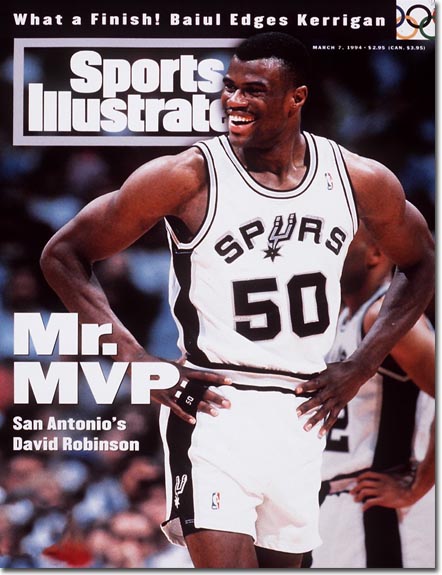
NBA MVP Awards: 1 (1994)
Top 2 in MVP Voting: 2 times (1993, 1994)
Top 3 in MVP Voting: 2 times ('93, '94)
Top 5 in MVP Voting: 6 times ('86, '89, '93, '94, '95, '96)
Top 10 in MVP Voting: 10 times ('86, '87, '88, '89, '90, '93, '94, '95, '96, '97)
NBA Finals MVP Awards: 2 (1994, 1995)
NBA Championships: 2 (1994, 1995)
Defensive Player of the Year Awards: 2 (1993, 1994)
All-NBA 1st Teams: 6
All-NBA 2nd Teams: 3
All-NBA 3rd Teams: 3
All-Defensive 1st Teams: 5
All-Defensive 2nd Teams: 4
2x League Leader in Rebounds: ('90, '91)
3x League Leader in Blocks: ('90, '91, '93)
NBA All-Time Leader in Blocks: (3,830)
Top 10 All-Time in Steals: (2,162)
11th All-Time in Total Points: (26,946)
13th All-Time in Rebounds: (13,748)
Hall of Fame: Class of 2008
Achievements:
All-Star Selections: 10
NBA Rookie of the Year (1990)
NBA MVP Awards: 1 (1995)
Top 2 in MVP Voting: 3 times ('94, '95, '96)
Top 3-5 in MVP Voting: 5 times ('91, '92, '94, '95, '96)
Top 10 in MVP Voting: 9 times ('90-'96, '98, 2001)
League Leader in Rebounding: (1991)
League Leader in Blocks: (1992)
Defensive Player of the Year: (1992)
League Leader in Scoring: (1994)
NBA Championships: 2 (1999, 2003)
All-NBA 1st Teams: 4
All-NBA 2nd Teams: 2
All-NBA 3rd Teams: 4
All-Defensive 1st Teams: 4
All-Defensive 2nd Teams: 4
Hall of Fame: Class of 2009
8. George Mikan (9 Seasons, NBL/BAA/NBA)
Regular Season:
PPG: 23.1
RPG: 13.4
APG: 2.8
FG%: 40.4%
FT%: 78.2%
Playoffs:
PPG: 24.0
RPG: 13.9
APG: 2.2
FG%: 40.4%
FT%: 78.6%
Achievements:
All-Star Selections: 4
All-NBA 1st Teams: 5
All-BAA 1st Teams: 1
NBA All-Star Game MVP: (1953)
BAA Championships: 1
NBA Championships: 4
3-time Scoring Champion: (1949, 1950, 1951)
9. Patrick Ewing (17 NBA Seasons)
Regular Season:
PPG: 21.0
RPG: 9.8
APG: 1.9
SPG: 1.0
BPG: 2.4
FG%: 50.4%
FT%: 74.0%
Playoffs:
PPG: 20.2
RPG: 10.3
APG: 2.0
SPG: 0.9
BPG: 2.2
FG%: 46.9%
FT%: 71.8%
Achievements:
All-Star Selections: 11
NBA Rookie of they Year (1986)
All-NBA 1st Teams: 1
All-NBA 2nd Teams: 6
All-Defensive Teams: 3
Top 5 in MVP Voting: 6 times ('89, '90, '92, '93, '94, '95)
Top 10 in MVP Voting: 7 times ('89, '90, '92, '93, '94, '95, '97)